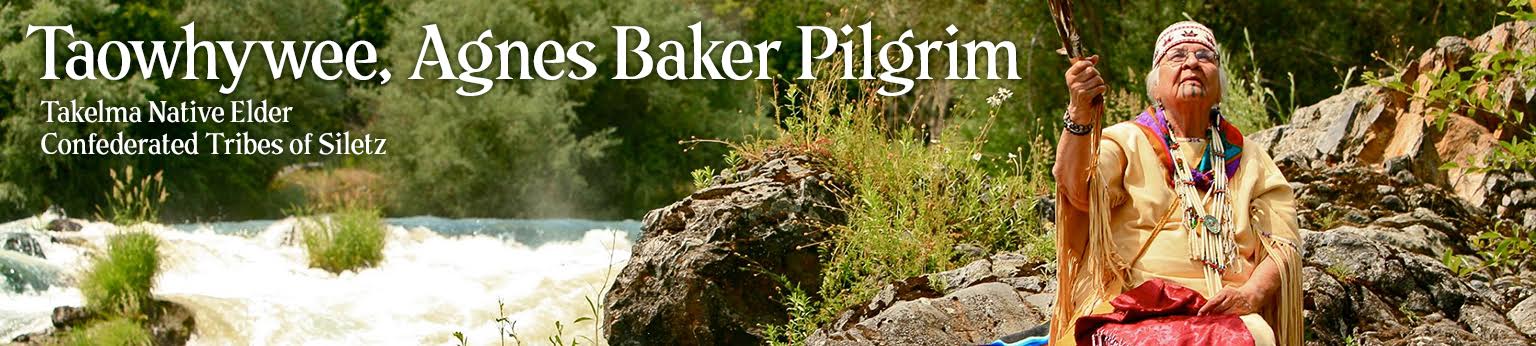
From November 12, 2026 Ashland News, by Peter Finkle:
For over 20 years a monument has stood tall for the Rogue Valley’s Indigenous people
A wood carving titled We Are Here — and a bronze replica — have declared the lasting presence of the Shasta, Takelma and other Native peoples who have lived in and around Ashland for centuries
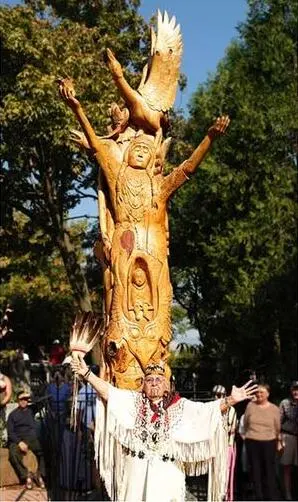
Grandma Aggie, who served as the model for the Native woman depicted in the artwork, dedicates the original We Are Here wood carving in 2006. James Royce Young photo
We Are Here, a sculpture honoring the Native people of our region, is one of the most meaningful and powerful public artworks in Ashland. Twenty years ago, Sept. 30, 2006, the original 20-foot tall wood carving from an alder tree was dedicated by the late Takelma elder Grandma Aggie. The artwork has been called a sculpture, a spirit pole and a prayer pole.
Historical background
We Are Here, as a spirit pole, remembers the thousands of years Native Americans lived on this land before the American pioneer settlers came and “claimed” it.
Between 1852 and 1856, there were four years of conflicts and broken promises as local Natives tried to defend their ancestral land. Suffering from diseases, hunger and deaths from the fighting, the remaining Shasta, Takelma and other Rogue Valley tribes were forcibly marched in 1856 to the Siletz and Grande Ronde reservations, more than 250 miles north along the Oregon coast.
Through the years, Natives have moved back to Southern Oregon. Grandma Aggie and her family came here because it is their ancestral homeland. Grandma Aggie’s daughter Nadine now lives in Grants Pass. We Are Here, as a prayer pole, is a living memorial — not just for the past, but also for the present and the future. That is why it is not called We Were Here; it is called We Are Here.
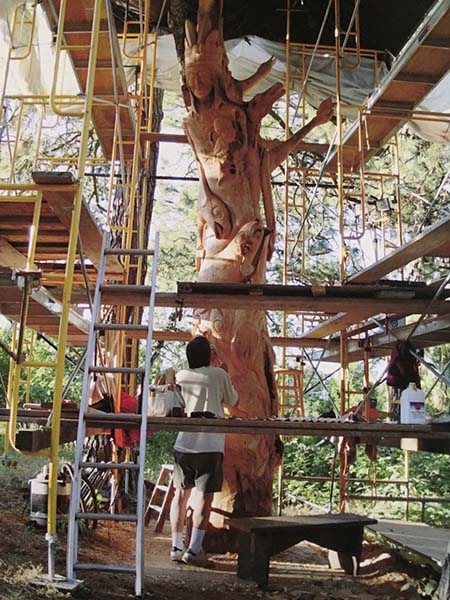
Russell Beebe carves We Are Here from an alder tree at his rural studio. Photo from Russell Beebe collection
Carving the tree
The sculpture was funded by local arts philanthropist Matthew Haines, who asked local Native sculptor Russell Beebe to do the carving.
Russell Beebe expressed: “Emotionally, this work brings forward those ancient ones of my own distant native roots and touches my heart. I feel the steady drumbeat of the seasons.”
Beebe’s grandfather was his first teacher in carving wood, and he also introduced him to tribal traditions. Beebe is a descendant of the Anishinaabe tribe in the north central United States and south central Canada.
The Shasta Man and Takelma Woman are both set toward the top of the sculpture. Before he started on the Takelma Woman modeled on Grandma Aggie, Beebe asked Aggie to bring him traditional Takelma garb, a cradle board and whatever else she wanted to bring. He explained, “I wanted to get that right.”
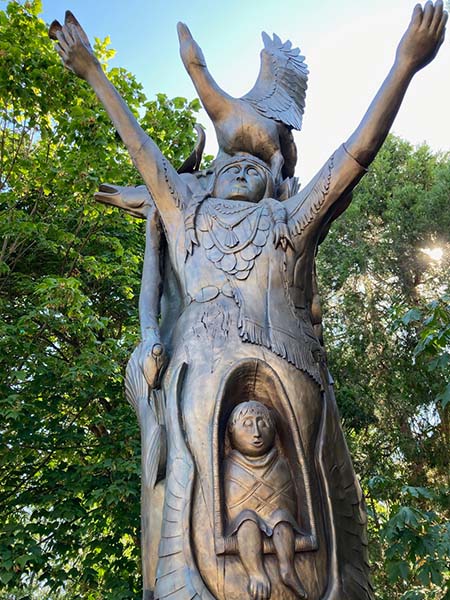
We Are Here depicts a Takelma woman, a likeness of Grandma Aggie, with a child. Peter Finkle photo
What the spirit pole represents
Beebe said, “Where we live now once were the Takelma, the Shasta and many other tribes. I couldn’t put them all on here, but I included those two.” The Shasta man and Takelma woman each have a child, who represent future generations, he said.
Representing the Takelma tribe is Grandma Aggie as she looked in her 30s, wearing her regalia.
“I got the blessing from her daughter Nadine,” Beebe told me with a laugh. “Nadine came out one day and looked at my depiction of the 30-year-old (Aggie). She said, ‘That’s Mom.’ So I got it right.”
Then he included many of the animals the Native people depended on and related to as kin: the deer, the sacred eagle, bear, beaver, mountain lion and many salmon.
“The dragonfly was put there just for Aggie,” he added. The dragonfly was one of her spirit animals.
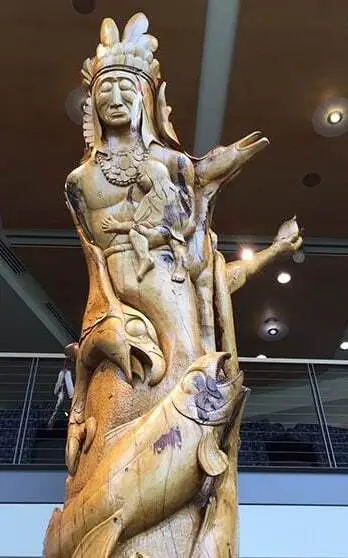
We Are Here includes detail of a Shasta man with a child. Peter Finkle photo
On the other side, Beebe carved a Shasta man and child. The Shasta people lived primarily in Northern California, though a branch of the tribe had a village right here, where Ashland Plaza and Lithia Park are now located.
We Are Here was dedicated Sept. 30, 2006, a day the Ashland City Council had recognized as First Nations Day. Grandma Aggie blessed the prayer pole and the assembled citizens.
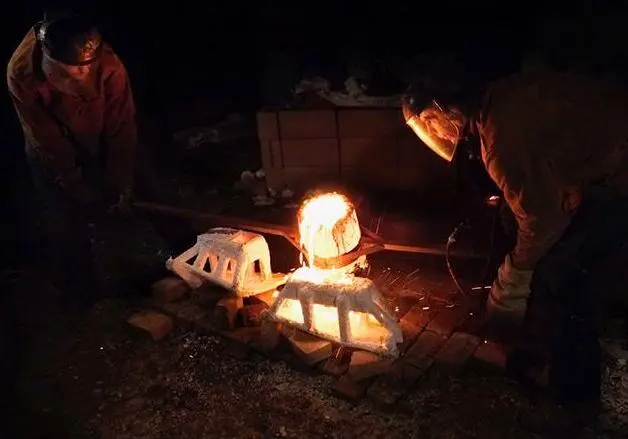
Molten bronze is poured into two of the 55 molds required to create the We Are Here bronze replica. James Royce Young photo
From wood to bronze, the story continues
Alder trees are a soft wood, and the rain, snow and ice of Ashland winters began to damage the sculpture after a few years. Beebe and Haines decided the wood carving had to be moved indoors in order to survive long-term.
Haines wanted to find a way to continue to honor Native Americans at this public spot. After discussing alternatives, Haines and Beebe decided that a bronze casting of the sculpture would be ideal.
Bronze casting is a complicated process, especially for an artwork of the size and complexity of We Are Here. Fortunately, the Rogue Valley has an experienced bronze artist: Jack Langford.
Langford worked on the bronze casting of We Are Here for more than a year. He began by erecting a scaffold around the wood carving and making a mold of it. But it was not just “a mold.”
The size of We Are Here required a total of 55 small molds to create the bronze replica! Creating each of the 55 molds was a complex, multistage, labor-intensive process. Then, after pouring 2,200-degree liquid bronze into each small mold, Langford had to reassemble the 55 bronze castings back into the complete sculpture you see here today.
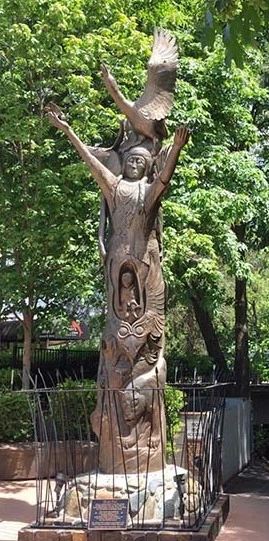
The bronze replica of the We Are Here wood carving. It sits now on North Main Street. Peter Finkle photo
Grandma Aggie’s praise
When the bronze replica was installed at the site in May 2013, Grandma Aggie said, “My name is Taowhywee, my Native name. My English name is Agnes Baker Pilgrim. … I’m very proud to stand here today to honor this statue that they’ve done, that Jack has done. What a beautiful spiritual thing it is to my heart. It will touch the lives of people that come by. The wood carving was here. Now this (bronze) will be here into perpetuity.”
Langford told me he was deeply moved by Grandma Aggie’s words to him the day his bronze replica of We Are Here was installed. She told him that she felt the presence of Spirit just as strongly in the new bronze replica as she did in the original alder prayer pole.
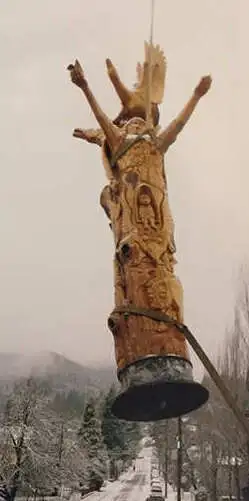
The wooden sculpture is moved from its place on North Main Street to SOU’s Hannon Library during the snowy dawn of Dec. 18, 2012. James Royce Young photo
We Are Here alder carving was moved
Matthew Haines had asked Grandma Aggie’s permission for a bronze replica of We Are Here to replace the wood sculpture outdoors on North Main Street. She said yes and suggested that the original be moved to the Hannon Library at Southern Oregon University. The city and SOU agreed, and the move took place on Dec. 18, 2012.
Grandma Aggie taught in Southern Oregon and worldwide
At SOU, Grandma Aggie helped found the Konaway Nika Tillicum (“all my relations”) summer Youth Academy to inspire, educate and uplift Native youth.
She reestablished the annual spring Salmon Ceremony on the Rogue River, which the Takelma people and neighboring tribes had performed for thousands of years.
She spoke to local gatherings small and large, adults and children. Her message was always one of love, of the sanctity of all life — including the basics of the water we drink and the air we breathe.
One of the 13 Indigenous Grandmothers
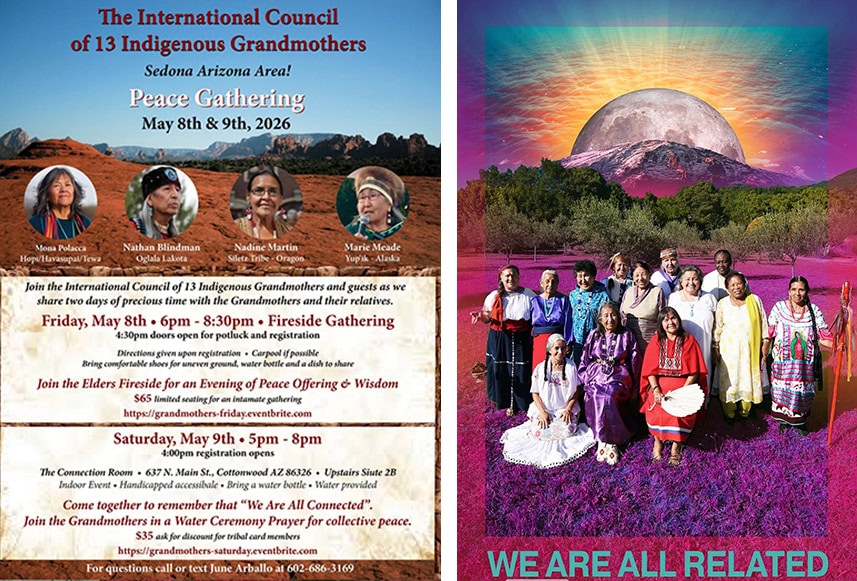
At left, an ad for a gathering earlier this year of the International Council of 13 Indigenous Grandmothers, where Nadine Martin was a featured speaker. At right, a 2004 photo of the 13 Indigenous Grandmothers, including Grandma Aggie. Photos from Facebook
She taught worldwide as a founding member in 2004 of the International Council of 13 Indigenous Grandmothers. These elders, teachers and spiritual leaders from indigenous communities around the world have prayed and taken action for the people, animals and plants of our world. Here is part of their mission statement: “We, the International Council of 13 Indigenous Grandmothers, represent a global alliance of prayer, education and healing for our Mother Earth, all Her inhabitants, all the children, and for the next seven generations to come.”
Grandma Aggie traveled to six continents of the world with the Indigenous Grandmothers. As Grandma Aggie spoke throughout America and the world, her daughter Nadine Martin traveled with her. Since Grandma Aggie’s passing in 2019, Nadine has become a teacher and board member in the group.
If you would like to read Grandma Aggie’s teachings in her own words, her book, “Grandma Says: Wake Up, World!” is available as a paperback and audiobook at Ashland Library. The website for the International Council of Thirteen Indigenous Grandmothers is here.
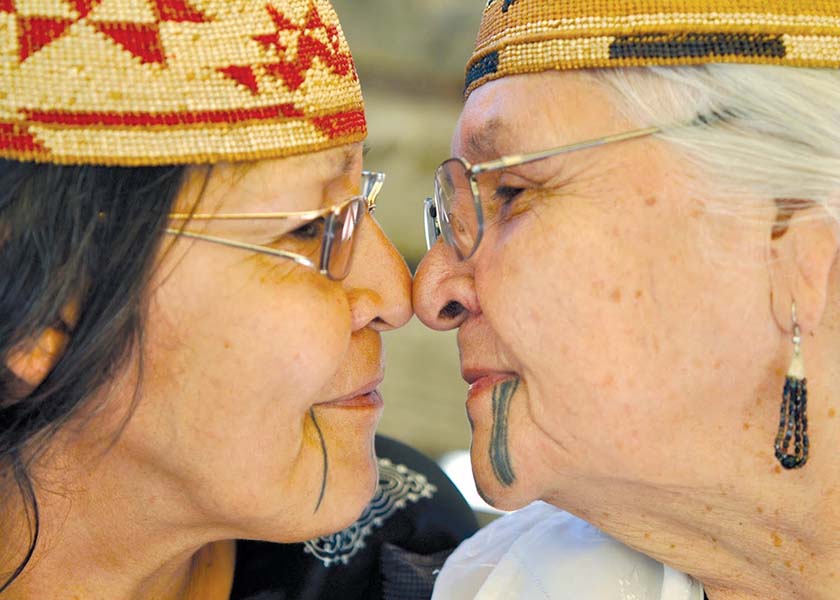
Nadine Martin, left, with and her mother, Agnes Baker Pilgrim, also known as Grandma Aggie. Photo courtesy of Nadine Martin
Takelma elder Nadine Martin, injured in fall, seeks financial help
Takelma elder Nadine Martin, daughter of the late Indigenous activist Agnes Baker Pilgrim, aka Grandma Aggie, needs the community’s help at this time.
Nadine, a resident of Grants Pass, dedicated decades of her life to traveling the world alongside her mother.
From the GoFundMe page for Nadine:
“On Aug. 9, 2026, while attending the Siletz Powwow, Nadine suffered a severe fall that resulted in a fractured knee. This injury has left her completely unable to walk. Since the accident, she has been confined to a care facility, receiving medical treatment and undergoing intensive rehabilitation. While she is working hard to heal, the road to recovery is long, and she faces significant challenges as she prepares to eventually transition back to her home.
“The funds raised through this campaign will go directly toward ensuring Nadine has a safe, stable environment to recover in. She will require home care assistance once she is discharged.
“Additionally, your donations will help cover urgent, long-delayed home repairs and appliance replacements — including fixing her broken dishwasher and broken washing machine — so that her living space is functional and safe for her return. Please consider giving back to a woman who has given so much to preserve and protect Indigenous traditions. Any contribution, no matter the size, will make a profound difference in Nadine’s recovery.”
Peter Finkle leads Ashland walking tours. See WalkAshland.com to learn about his tours, or to request a private tour for your group or family.